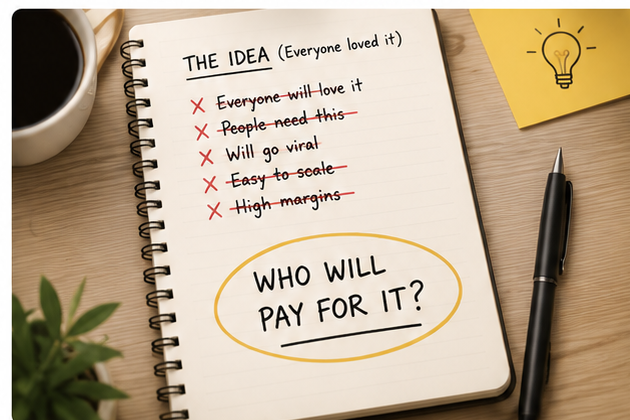
Everyone around him thought it was a
brilliant idea.
His friends wanted to be the first
customers. His family thought he had finally found his business. Even the first
few numbers looked promising.
So he did what excited first-time
entrepreneurs often do.
He started building it.
There was just one small problem.
He hadn't asked
enough customers what they actually wanted.
The Idea
He wanted to open a premium café.
Not just coffee and chairs. Something
polished. Beautiful interiors. Good music. A menu people would photograph
before they tasted it.
His friends loved the concept. His family
encouraged him.
He looked at successful cafés nearby and
thought he had found the formula.
It all looked perfect — on paper.
So the logo came first. Then the menu. Then
the furniture. Then the numbers.
The business was becoming real before the
most important thing had happened.
A real customer had said, “I would pay for
this.”
The Reality
Check
Someone eventually told him to stop planning
and start asking.
So he did.
He spoke to students. Office workers.
Families. People who already visited cafés. People who rarely did.
The conversations were uncomfortable.
People liked the idea. They liked the
pictures. They liked the thought of a new café.
But when he asked the question that
mattered, the answers changed.
“Would you actually pay for this?”
Some already had a favorite café. Some
thought it was too expensive for everyday use. Some wanted somewhere quieter.
Some wanted reliable Wi-Fi and power points.
Others simply said they didn't need another café.
His idea wasn't terrible.
It was just solving a problem people weren't
asking him to solve.

The Difference
Between Liking and Buying
This is where many business ideas become
confused.
People can like an idea without needing it.
They can praise a product without buying it.
They can say, “That's cool,” and never spend
a rupee on it.
For an entrepreneur, that difference
matters.
A business is not built on applause.
It is built on a problem important enough
for someone to pay to solve.
The question
changed from “Do people like my idea?” to “What are people willing to pay for?”
The Pivot
He didn't abandon the café.
He changed what the café was actually trying
to solve.
Instead of building another premium café, he
started exploring a different idea.
A place for people who needed somewhere
comfortable to work for a few hours.
Reliable Wi-Fi. Power points. Quiet corners.
Good coffee and quick food. Flexible hours.
The café was still there.
But the reason for visiting had changed.

What Changed?
The first idea was built around what he
thought people would enjoy.
The second was built around what people had
already told him they needed.
That difference sounds small.
In business, it can be everything.
Five Lessons
From One Expensive Idea
- Talk to customers early.
Not after the logo. Not after the interiors.
Before the money is committed.
- Validate the problem, not just the solution. Ask what people
struggle with before asking whether they like your product.
- Listen more than you defend. If every piece of
feedback becomes an argument, you're collecting compliments, not learning.
- Test small. A smaller experiment can teach you more cheaply than a full launch.
- Build for real demand.
The strongest idea is not always the most
exciting one. It is the one people have a reason to choose.
A Business Idea
Is Not a Business Yet
This is not an argument against big ideas.
Big ideas matter. Ambition matters. Good
design matters. Investment matters.
But all of them become more useful when they
are connected to a real customer and a real problem.
That is why experienced entrepreneurs test
assumptions before they become expensive decisions.
They don't try to prove that their idea is
brilliant.
They try to find out whether it is useful.
And That
Changed How He Thought
Months later, the business finally opened.
It was smaller than his original plan.
Simpler too.
But people came.
Not because his friends had promised they
would.
Because the business had become useful to
them.
And that taught him something he couldn't
have learned from a spreadsheet.
A business does
not become stronger when more people say they love the idea. It becomes
stronger when the right people have a reason to buy it.
The
Entrepreneurial Lesson
Entrepreneurship is often described as
having the courage to start.
There is another kind of courage that
matters just as much.
The courage to change your mind.
To hear that your favorite part of the idea
isn't what customers need.
To test before spending.
To simplify instead of adding.
To build around reality rather than
assumptions.
Sometimes the best business decision is not
saying, “This is my idea.”
It is saying, “Tell me what I am missing.”
Where NFIS
Comes In
NFIS brings entrepreneurs, investors and
franchise brands into one ecosystem where ideas can move from conversation to
informed decision-making.
Because the right business opportunity is
not simply the one that sounds exciting.
It is the one that makes sense for the
customer, the market and the person building it.
EXPLORE. COMPARE. CONNECT.
NFIS — National Franchise Investment Summit
Connecting franchise brands, investors and
entrepreneurs.